I suppose you are wondering why I
haven't been writing, now that the war is
over. Well, the truth is we have been on the go
all the time rounding up and herding together
all the Germans that were left here in
Czechoslovakia. We have them all now, or rather
the Russians have, for we turned them over
to them. So this war is now over for us.
Incidentally, the Russians deported large
numbers of the Krauts to Siberia to work,
which is good enough for them.
Well most of the censorship rules have
been relaxed so now I can tell you a
few interesting facts. I sailed from New York
harbor on the Queen Elizabeth. As you know,
it is the largest ship in the world and I
can well believe it. The trip itself was
very uneventful. There was nothing for us
to do all day every day except read & sleep.
We ate twice a day (the meals were horrible)
and we had one hour lifeboat drill from 12 to 1
every day. We zig-zagged our way across the
Atlantic without convoy until one morning
I came on deck bright & early and there
off on the horizon was a purple haze
which I knew right away was land.
It didn't take long for the land to sort
of sneak up and surround us on all
sides for before I knew it I was
2
gazing at the hills of Scotland. We were in
the Firth of Clyde. As much as I hate to
admit it (me being a good American) I have
never in all my life seen such a beautiful
country. The green rolling hills slope down
right into the sea. Their sides are dotted
with lone farm houses, little fishing villages,
rich country estates, and even medieval
castles. All in all it was a site which I
shall never forget. We continued up the
Firth of Clyde and dropped anchor at a
small town called Greenock, which is a
suburb of Glasgow. There we were loaded on
trains and went thru Glasgow, then
Aberdeen, down the east coast of the
British Isles to Portland which is just
below Portsmouth. We got off the trains
and there, staring us in the face, was
the wide open mouth of an LST (Landing
Ship, Tank). We marched from the train on
to the boat and that was the end of
our stay in England. We stayed that night
in port but on the following night,
under cover of darkness we made our dash
across the channel. When the sun came up
the next morning we could see the
battle scarred city of Le Havre. The sea
was too rough for us to land that day
so we just stood off shore and got
tossed around like a toothpick. About 90%
of the boys got seasick. I think the
fresh air helped me for I stayed on
deck and wasn't bothered at all.
3
The next morning we landed and after
few hours rest were again loaded up on
trains. Right there is the greatest crime
of the war. They put 44 men in one of
those little 40 + 8 boxcars which are about
half the size of our freight cars
back home. To be comfortable was impossible.
You couldn't sit down without sitting
on somebody, and it was bitter cold.
We rode that way for 5 days & nights.
We arrived at Thionville France, near the
Luxembourg border. There, we were broken down
and assigned to our different outfits. I drew
the Fourth Armored Div., Gen. Patton's Finest.
I was driven to my outfit in a truck. The
company was then enjoying a rest period at
the town of Steinsel in Luxembourg. We stayed
there a few days. I spent those days
wandering around town, trying out my French,
and playing cards & chess. We then went up
on the front which was then along the
Our River, the border of Luxembourg & Germany.
We took up a defensive position near
Diekirch and lived in our foxholes there
for 21 days. As for misery, that was the tops.
It rained almost every day and we were
continually cold & wet. As for danger there
was hardly any. We could see the Germans
walking down their Siegfried Line and I
imagine they could see us. We didn't bother
them, they didn't bother us. Occasionally
we would shoot a few shells at them
and they would throw a few back. Every
night we would both send out patrols, but
that is about all the action there was.
4.
After 21 days of that we went back for
another rest. That rest lasted about 2
days. Then the order came to move
out.
Before I go any farther, I think I should
tell you something about an Armored Div. It
is the Armored Div. job to spearhead the
attack. It ranges out far in front of
everything & everybody else. It cuts a path
for the regular Infantry Divisions that
come up and follow it. Its job is to keep
going. It never goes near any large cities for
there is not enough infantry in the division
to take care of a large city. They bypassed
the big cities and go around them. Leave
them there for the infantry divisions to
take care of. Whenever they meet real heavy
resistance they just hold on, let the
infantry come in and take over, and then
withdraw.
Well, anyway, we loaded up on our half-tracks
and started to ride. We rode again to the Our
River and crossed it on a pontoon bridge.
It was there I saw a sign which read
"You are now entering Germany. Be on the alert."
We were beginning the last spearhead. The
spearhead thru Germany. On both sides of
us was the wreckage of the Seigfried
Line. We passed those villages that were
still burning from the battle. We knew
we were not too far behind. We continued
following the spearhead for 2 days, then
5
we went up to the front of it ourselves.
The first few days of spearheading
in Germany were easy. We would ride on
tanks up to the outskirts of a German
village then we would sit around and
wait for about a half an hour while
the tanks shot the living blazes out
of the place. Then we would move in
with the tanks and simply get the
Krauts out of the cellars. It was as
easy as that. I knew our luck couldn't
last forever and sure enough 3 days in
a row we ran into more than we
could handle and got shot up pretty
badly. This took place near Bittburg,
Germany. They brought us back to reorganize.
When this was accomplished we took off
again this time driving up to within a
few miles of Koblenz and the Rhine. They
brought us back and we crossed the Moselle
River at the town of Carden. We then spearheaded
south to the city of Bad Kreuznach. We then
swung north and crossed the Rhine near
Worms on the night of Mar. 24. The next day we
took Pfungstadt & Darmstadt. At Pfungstadt I
got me a nice German flag about seven
feet long which I now have with my
souvenirs. At Darmstadt, which is the biggest
and best German city I saw (It was best
because it was bombed level to ground) we
captured 200 German officers. Then a German
captain surrendered to me his personal
rifle. Boy! It's a beauty that is also one more of
my souvenirs. I also got a German Luger pistol
6
from another officer there. From there we made
a wild dash for the city of Gotha where
Gen. Von Kesselring had his Hqs. It was
during that drive that we went so fast
they had to send airforces out to find us.
We almost caught Von Kesselring at Gotha to but
he got out before we took the place.
Then we started what proved to be our
final drive of the war. We were told that we
must drive out and meet the Russians
somewhere between Dresden & Chemnitz. We took
off again and in no time at all we
were sitting in the hills overlooking
Cheminitz watching the German Army doing
physical exercises in the fields below.
They had no idea that we were within
a hundred miles of them. We sat there for
a few days until an Infantry Division
came up to take Chemnitz. We went back for
a rest. After about a week's rest the order
came down to move out. We were going to
take Berchtesgaden! Sure enough, we headed
down towards southern Germany, towards
Nuremberg & Munich. However, when we got there
they put us to work as policemen. That
lasted for a few weeks, until word came
that the [patriots?] of Prague had asked for help.
So off we went to Czechoslovakia. We
were well on our way to Prague when the
order came to "[Cease Firing??]." and that was the
end of it. Right now I am at the small village
of Steken which is near 2 large cities, Pisek &
Strakonice. We expect to march anyday now
back into Germany.
Now don't let what I am about to
7
say get your hopes up. When we go back
to Germany we are going back as
occupational police. We have already been
assigned our area. However, we don't know
how long the situation will last. I may
be in the Pacific as fast as the next
guy. You never know what is going to
happen. As for home, you need 85 points. I
have 35.
Well, I guess that is enough for now. I
hope this letter makes up for not having
written. So long for now.
Your Loving Son,
Oby
Description
Transcription of 1980s xerox. Original in USHMM archives.
Written after Germany’s surrender, this long letter offers Dad's first uncensored account of his wartime experience. He describes sailing to Scotland aboard the Queen Elizabeth, joining Patton’s 4th Armored Division, enduring cold defensive positions in Luxembourg, and then spearheading the final Allied drive across Germany. He recounts crossing the Rhine, capturing German officers, racing toward Chemnitz to meet the Russians, and being redirected from Prague at the war’s end. Though relieved the European war is over, he notes he has only 35 discharge points and may yet be sent to the Pacific.
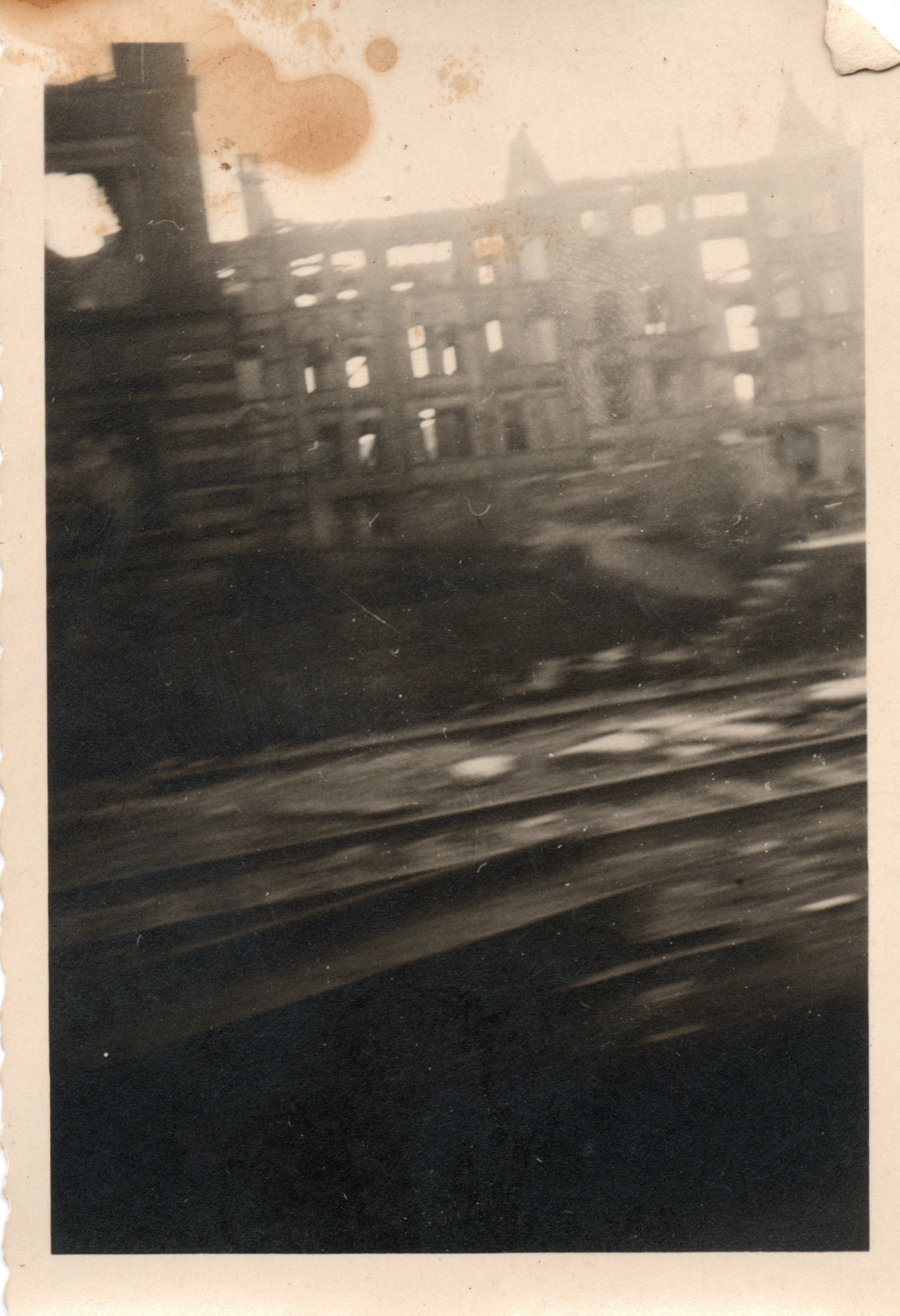
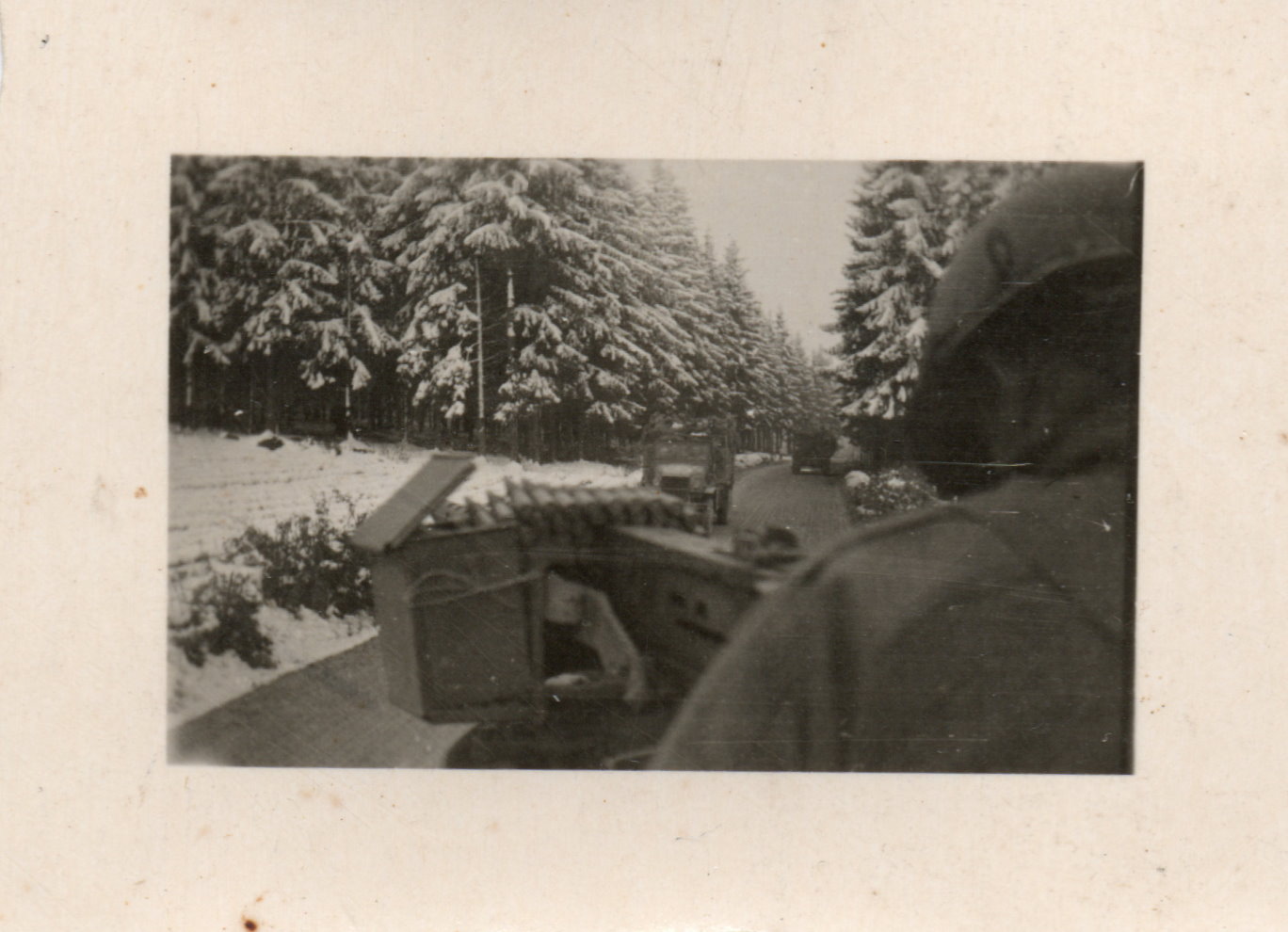
No specific pictures to include so included a couple of random pictures that were not clear where/when they were taken.