Well we are still rolling along
like "Old Man River." The Krauts
are going to have to do a lot
better than they have been doing
if they expect to stop us. You
asked what organization I am in.
Well, I am with Patton's 3rd Army,
and, if you want to follow my
progress, just watch the farthest
points of the 3rd Army's advance.
We were so far out in front at
one stage of our trip through
Germany that we lost radio contact
and they had to send Thunderbolts
(P47s) out to find us.
Yesterday, I experienced something
that I shall never forget. Our
outfit captured a town which
contained a concentration camp for
Polish and Russian prisoners. It
was one of the most morbid and
gruesome places I have ever seen.
The place contained 30,000 prisoners.
It was completely surrounded by
2 barbed wire fences about 10 ft.
high. In between each fence was
coils of barbed wire making it
all but impossible to escape. At
regular intervals there were
towers from which the guards
2
could watch the camp. We entered
the main gate and examined the
first cell block. It was a long
low one-story building with about
24 cells, 12 on each side of a long
corridor through the middle.
The cells were filthy holes. From
what I gather they each contained
about 6 or 8 men. There were
filthy sacks filled with straw
thrown on the floor. These were
their beds. There were no toilet
facilities except a bucket in
each cell. The stench in there was
so great we couldn't stand it.
We retreated to the fresh air.
We continued on through the
camp until we came to what
appeared to be the central
courtyard. There for the first
time I saw with my own eyes
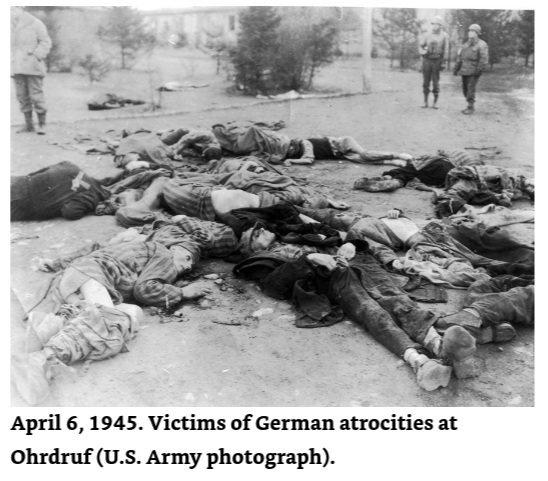
Nazi brutality. There in the
courtyard were 28 or 30 bodies
laying right where they had been
machine gunned when the
Nazis left. It was easy to see
that they had all been starved
for they were all emaciated.
One was an American pilot. We
learned later that these had been
the crippled and sick from the
hospital ward. The Nazis found
it inconvenient to evacuate
them so they simply herded them
3
into the courtyard and shot
them. We continued on and accidentally
stumbled on a shed that contained
about 50 more naked bodies stacked
up in a neat pile like a cord of
wood. These bodies had been
efficiently dusted with lye.
Nearby stood a deep lime pit
with catwalks over and around
it. It was apparently their
intention to dispose of the bodies
in the lime pit. That sight was
enough for our weak stomachs
so we left "plus vite." These
things I have seen with my own
eyes. I didn't read it in a
magazine. I saw it. I have
tried to set it down here in
words so that you will get
an idea what we are up
against. However, words can't
describe all the horror I saw.
Well, so much for the war.
I received a nice Easter card
from Mrs. Sullivan. John is still
in Nebraska. His brother Eddy is
somewhere in the Philipines.
About my pay. I sent it home
last month. You should have
received it by now. If not, I
still have the receipt. It amounted
to a little over a hundred
dollars. However, you mustn't
expect to receive my pay
4
regularly every month. You will
only be able to receive it when
I get paid and circumstances
don't allow that to be very
regular. However, if I dont get
it this month, I get twice as
much next month, so it all
works out.
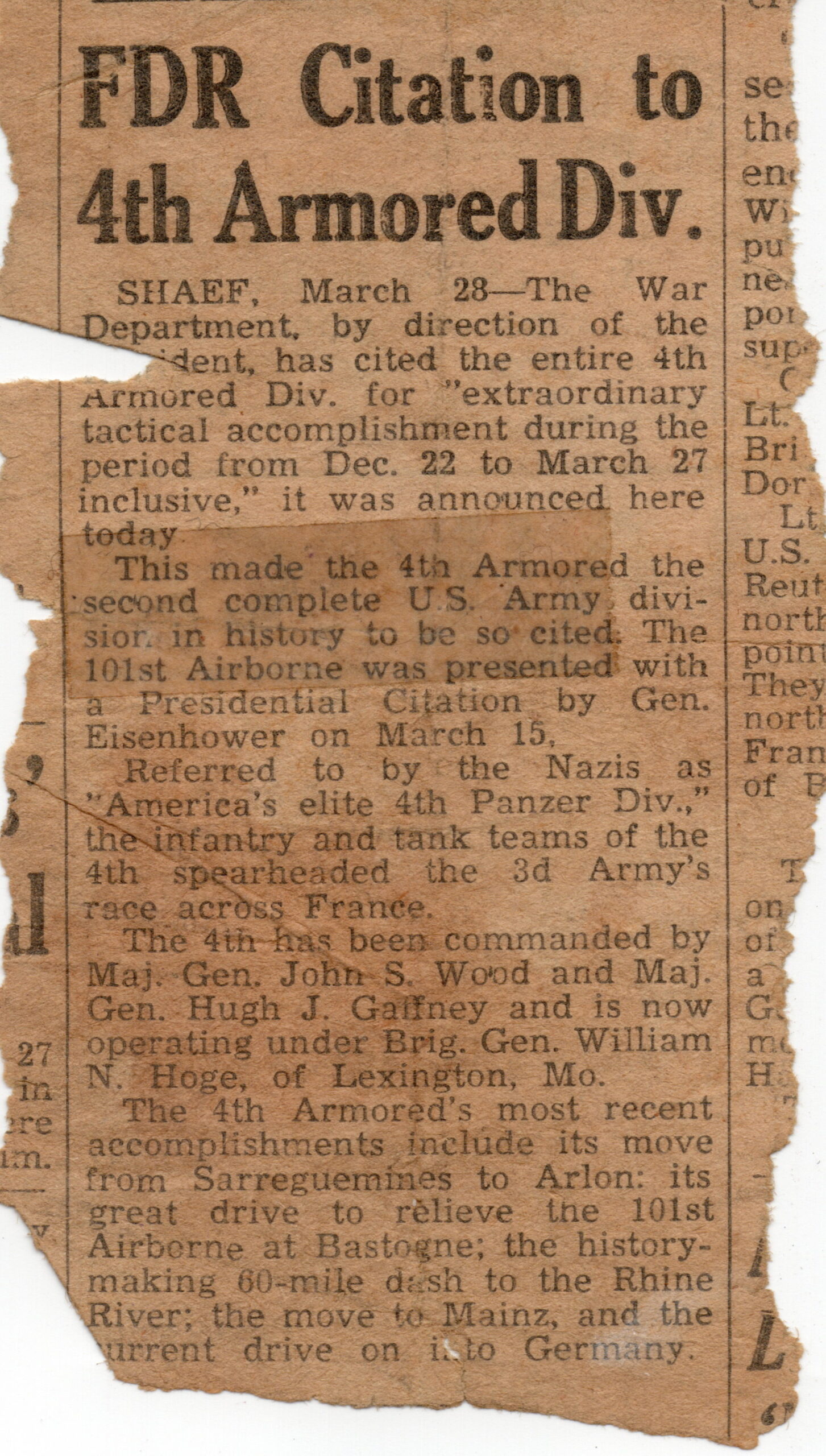
Oh yes! I am proud to say that
our division was awarded the
Presidential Citation. We are the
second complete Army division in
history to receive it. It was
given to us for our work in
the drive through Germany.
Boy! I'll have ribbons all over
me when I get home.
Well, I guess that is all
for now. Please send me a
box of foodstuffs if you
get a chance. Oh yes! Please
send me some air-mail stamps.
Well, so long for now.
Your Loving Son,
"Oby"
Tags
camps
Description
April 9, 1945 Letter - Context and Description
Transcription of 1995 Xerox copy of original. The original was submitted to the archives of the U.S. Holocaust Memorial Museum.
Timeline and Dating
The timing of this letter is somewhat uncertain, as soldiers often lost track of days during combat. The letter was dated April 9, and references discovering Ohrdruf the day before. Ohrdruf was liberated on April 4, 1945. The After Action Report for that date (available here, pdf page 126: https://cgsc.contentdm.oclc.org/digital/collection/p4013coll8/id/3769/) provides minimal information, referring readers to the "Company Commander's Meeting" in a separate Journal that isn't readily available.
The Battle for Gotha (April 3-4, 1945)
On April 3 (pdf page 125), Dad's battalion B/51 and battalion B/35 advanced through woods east of Metebach, Germany, with orders to attack Gotha from the west while other units approached from the east (Goldbach/Nessetal). The "B" teams were to lead the main attack. As they moved through the woods, they encountered heavy resistance—infantry equipped mostly with telescopic sights, bazookas, and 20mm guns. After clearing the woods (15 enemy killed, 25 captured), they faced sniper fire from buildings as they approached the city outskirts.
Infantrymen, including Dad, cleared houses on both sides of the street with tank support. As the column reached the town square, an 88mm anti-tank gun knocked out one of the lead tanks. Enemy riflemen and bazookamen opened fire from all sides—they were pinned down. "C" Company launched a diversionary attack on the main road to draw fire away, encountering equally fierce resistance. Both "B" company commanders were killed by sniper fire. The surviving forces withdrew to high ground on the town's edge and dug in for the night.
Dad once described the one time he was certain he would die: pinned down with another soldier in a doorway, taking fire from every direction, he heard "clink clink"—a German "potato masher" grenade landing at his feet. I can't recall if he described that his life flashed before his eyes or whether he was surprised it didn't, but he was saved by good fortune. Nearing the war's end, the Germans were running low on ammunition, and the grenade cylinder was empty. He assumed the Germans hoped the sight of it would flush the soldiers into the open where they could be picked off. It didn't work. Reading this After Action Report, I wonder if this incident occurred here in Gotha.
The next morning, April 4 at 8 AM, Gotha surrendered. The After Action Report notes only that Combat Command then moved to attack Ohrdruf, completed by Command Company A, with a reference to the Company Commander's S-3 Journal. The Battalion Command Post was established in Muhlberg by 6 PM that evening, roughly 20-30 miles east of Gotha or Ohrdruf.
Discovery of Ohrdruf
Dad described discovering the Ohrdruf concentration camp with a friend one day after battling. After digging in for the night, they went foraging for food to supplement their K-rations—looking for rabbit, small game, chickens, or eggs. They spotted low, long structures resembling chicken coops and hoped to find eggs. Inside, they found shelf-like bunks stacked impossibly close together, clearly not designed for chickens but barely fit for humans. Personal belongings left behind made it obvious these were sleeping quarters, though the conditions were inhumane.
In the letter, Dad describes reaching a courtyard where 28 or 30 bodies had been machine-gunned, including an American pilot identifiable by his leather jacket. When he recounted this later, he emphasized that he and his partner had completely different reactions. His friend's response was immediate: "That's it. No prisoners." And he followed through on that thru to the end of the war. Dad's reaction was the opposite: "My God, human beings did this! Human beings did this to other humans. I'm a human being. This could have been me." To kill another human being in such a way would make him one of them. He didn't become a pacifist—he still believed in fighting to defend himself and others—but when Germans surrendered, he took prisoners. He never judged his friend's reaction; he understood it completely, but his own was different.
Dad also described returning to camp and trying to report their discovery to commanders, but they couldn't find any. They went back to their foxhole and told others what they'd witnessed. Soldiers took turns going to see for themselves. This aligns with the After Action Report, which references only the Company Commander's Meeting; clearly the Commanders were off somewhere.
A more detailed description of what soldiers witnessed at Ohrdruf and the reactions of Generals Bradley, Eisenhower, and Patton appears in Fox's book (pp. 442-446). What Dad described in his letter as "enough for our weak stomachs" is illustrated by Fox's account: Patton "retreated to the side of a building and vomited." Also in the records of the 89th Infantry Division which "officially" liberated the camp (https://89infdivww2.org/ohrdruf/index.htm ).
The Commanders and the Nazi Gold?
Later, Dad learned why no commanders were available: a stash of Nazi gold had been discovered in a cave, and all the commanders had gone to investigate; or so he was told.
This was most likely the discovery of Nazi gold in a potassium mine near Merkers, Germany. While some elements of Patton's Third Army advanced northeast to capture Gotha and Ohrdruf on April 4, others moved east toward the Werra River. The 90th Infantry Division captured Merkers on April 4, 1945, unaware until after the capture that it contained a vast underground cache of Reichsbank gold and valuables.
Presidential Unit Citation
Between his last letter on March 23, and this letter in early April, soldiers were informed that the Fourth Armored Division was awarded a Presidential citation, the Distinguished Unit Citation. It was specifically to recognize actions during the period Dec. 22 through March 27, which were their actions during the Battle of the Bulge (Ardennes–Alsace campaign) and the subsequent Third Army advance into Germany through late March 1945. (more on this later)
There is also video footage of the 4th Armored Division taking the city of Gotha. Dad's unit had already moved on, but this is what the city looked like after the city surrendered.