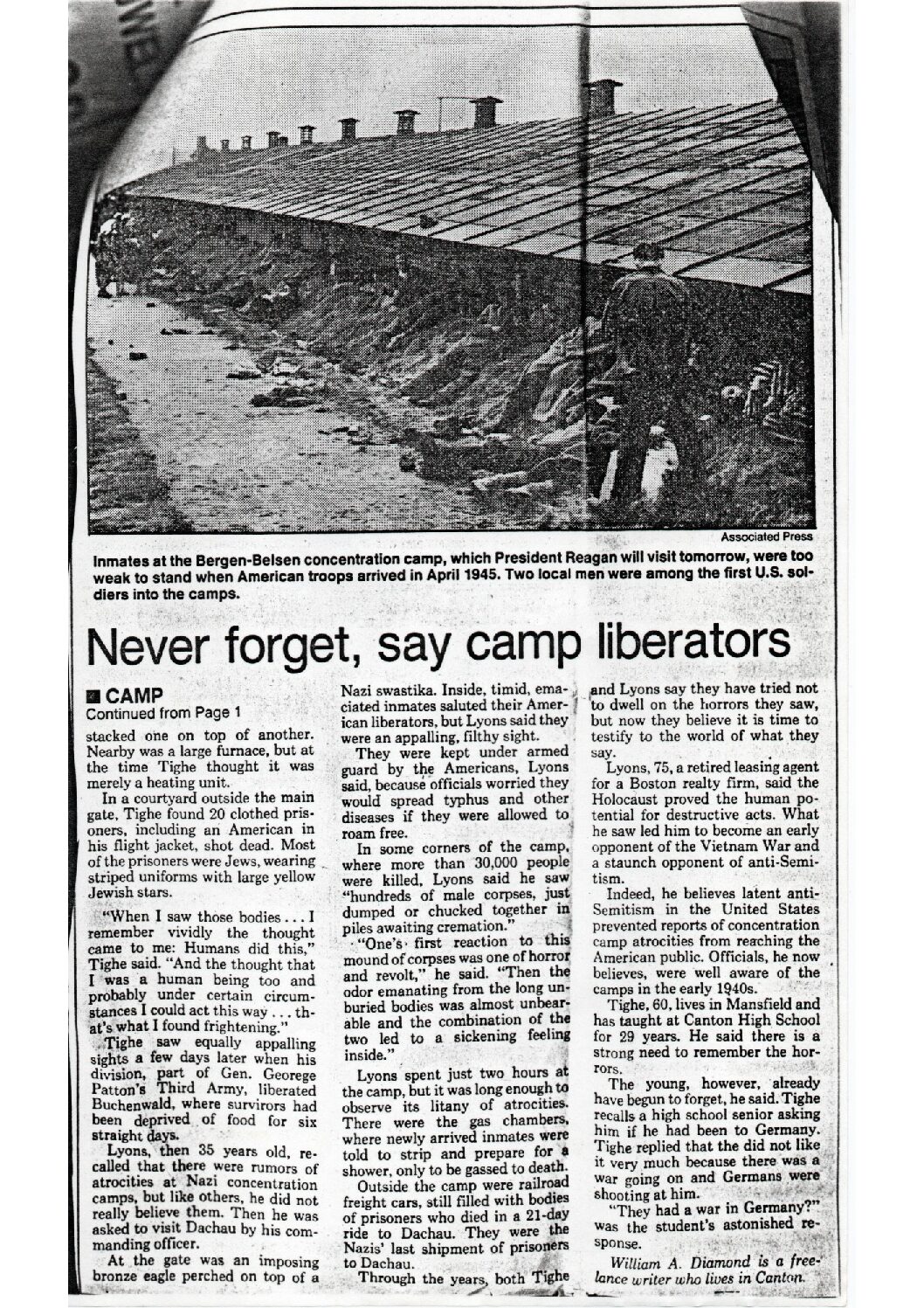
quincy_patriot_ledger_4may85
Local newspaper story describing his experiences with the camps retold as part of the 1985 BU Hillel project.
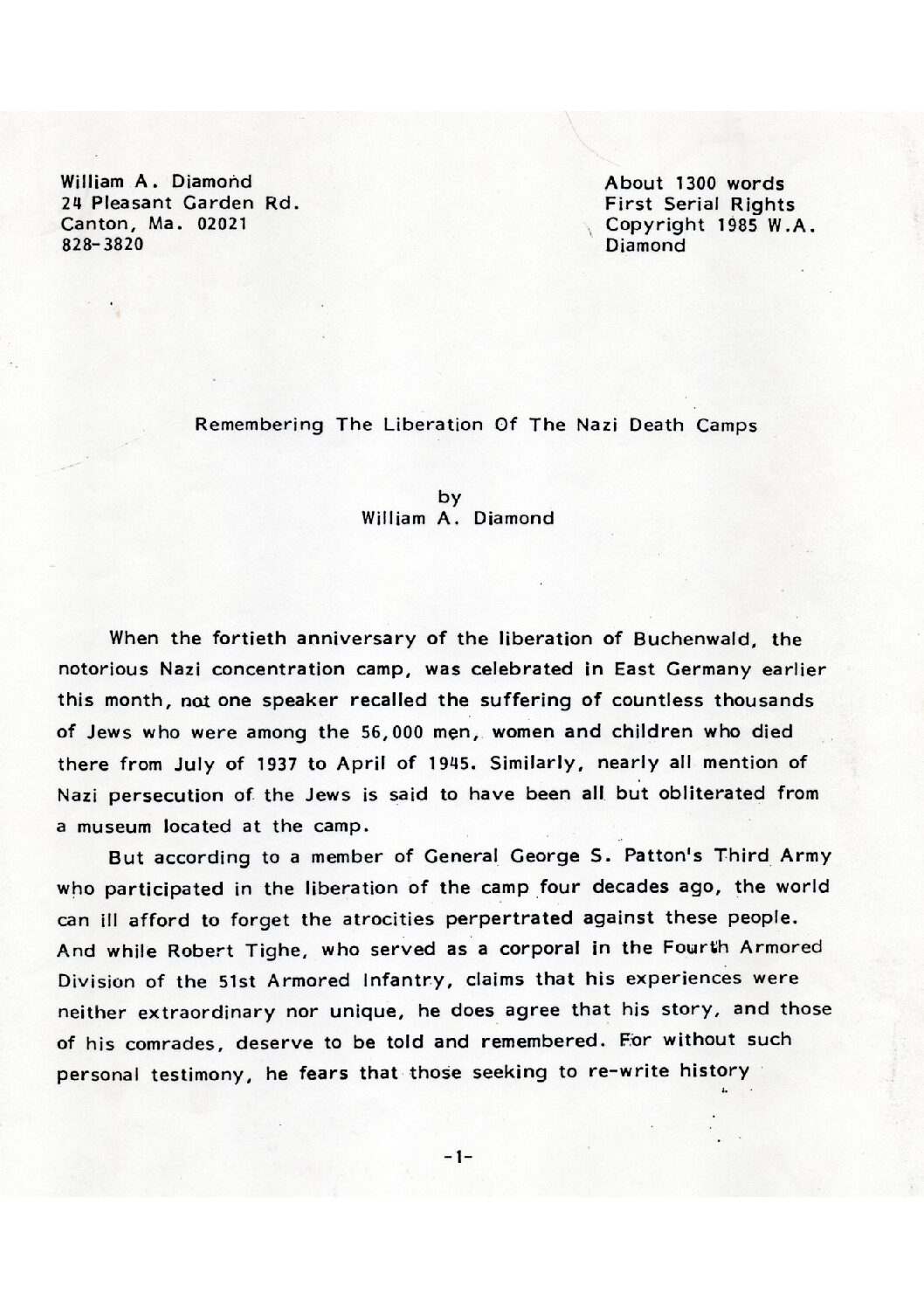
diamond_1985
Longer article written by William Diamond which summarizes my father's experience.
Metadata
Share
Title
04-17-1945 Buchenwald Concentration Camp
Date
April 17, 1945
Location
Germany
Transcription
Germany,
Apr. 17, 1945
Dear Mother & Dad:
I'll bet you are worried sick
about me because I have not written to you.
However, if you have been reading the
newspapers, you will know that I haven't
had very much time. We have been chasing
Krauts day & night. Why they continue fighting
is beyond me. All hell is breaking loose
around them.
We were all shocked to hear about
the death of President Roosevelt. It is a
shame he couldn't be around to see the
finish of this thing. He, like all of us, had
his faults but I think that he always
tried to do right.
We heard of the president's death in
an odd way. We liberated a concentration
camp containing thousands of Jewish civil
prisoners. That was the first thing
they wanted to talk about. I wish you
could have witnessed that scene. They
crowded around us and held up our advance.
They laughed & cried, mostly cried. They kissed
our feet and any place else they could reach.
2
They told us of thousands of their friends
who had been brutally murdered in gas
chambers at the camp. It was a
pitiful sight.
I was glad to learn that you received
the $103. Now I can throw away the receipt.
I sent around $60 home the other day. You
should be receiving it soon.
We had our pictures taken by a
Pathe' News cameraman the other day. Look
for me in the newsreels. I'm a movie
star now.
Well, I guess that is about all for
now. I will write again at first chance. Keep
watching the 3rd Army. So Long for Now.
Your Loving Son,
"Oby"
Tags
camps
Description
April 17, 1945 Letter - Context and Description
Transcription of 1990s Xerox copy. Original held in the United States Holocaust Memorial Museum archives.
This letter describes the liberation of Buchenwald concentration camp and learning of President Franklin Delano Roosevelt's death from the prisoners. He also references being filmed by a Pathé News Reel cameraman.
Silence and Speaking Out
He didn't speak of his wartime experiences until the early 1980s. When he returned from the war, he tried sharing what he'd witnessed but repeatedly heard "the war is over." People didn't want to listen, so he learned to stay silent.
Thanks to Eisenhower's expanded GI Bill, my father attended college—previously financially impossible despite his deep interest in education. A devout Jesuit-tradition Catholic who had considered the priesthood, he ultimately saw teaching as his "ministry," since Jesus himself was a teacher.
After the war, he immersed himself in history, philosophy, literature, and languages—driven by curiosity but also trying to understand what he'd witnessed. Frustrated during the Army of Occupation by his inability to communicate with Germans and understand how such atrocities occurred, he became fluent in German and French, gained teaching credentials in Spanish and Italian, and learned Russian and basic phrases in many languages. Connecting with people in their own language was important to him.
Breaking the Silence
After years of teaching, he found that students knew increasingly little about World War II and Nazi atrocities. Additionally, revisionist history and Holocaust denial were rising, along with neo-Nazism in the US—including Nazi attempts to march in Skokie, Illinois, home to many Holocaust survivors.
A colleague forwarded him an advertisement from Boston University Hillel seeking testimony from soldiers who'd witnessed Nazi atrocities. He responded, and graduate students came to our home, where he finally released the movie reel he'd been replaying in his mind for decades into the official record. The interview was part of an oral history project, "Project Liberators Remembered."
Barbara Howard of WBUR-FM Boston public radio drew on interviews with soldiers and survivors to create a four-part radio series, Liberation Remembered, which won a Peabody Award in 1985. https://peabodyawards.com/award-profile/liberation-remembered/
Following these interviews, he volunteered with the educational nonprofit Facing History & Ourselves, which brings lessons of history into classrooms to help students stand up to racism, antisemitism, and other forms of hate. He visited classrooms to share his experiences with students.
Final Testimony
The supplemental video below shows him speaking with students at Mansfield High School in 1995, a few months before he died from complications of lung cancer. Mansfield was where my mother was born and raised and where they settled after marriage, raising their eight children. At the time, my mother worked in the school library (he references this in the video). He recounts the details of what he witnessed and the dangers of it happening again.
More on Buchenwald and Nazi Atrocities
For details regarding what my father witnessed at Buchenwald, see from the Pathé News Archive, the atrocities of Buchenwald: https://cutt.ly/utd7gGVp
When we were old enough to express interest in the Holocaust, my father recommended we start with Eugen Kogon's book, The Theory and Practice of Hell. Kogon was a German Catholic intellectual and journalist, active in anti-Nazi circles, who was imprisoned in Buchenwald from 1939 to 1945 and survived. Immediately after liberation, Kogon worked with the U.S. Army’s Psychological Warfare Division. He was asked to document and explain how the camp system functioned—not just what happened, but how it was organized, administered, and sustained. Drawing on his own experience in Buchenwald (including working in administrative roles that gave him unusual visibility), and testimony and records from other prisoners and camps, he produced a structured report that became the basis for the book.
My father mentioned the Pathé News Reel in his letter. I don't know what specific footage this might be, but archives of Pathé News are available online. Here's one showing the 3rd Army taking the town of Mulhausen, Germany, which was after Ohrdruf and likely before the liberation of Buchenwald, around the same timeline: https://cutt.ly/Ftd7D9r9
There is also US Army Signal Corps footage of the 4th Armored Division drive through Kuhnhausen, Germany on April 12, 1945:
In the video, during question and answer period, he tells the story of working in the Office of War Information as a messenger boy before being drafted, and hitting Winston Churchill in the face with a swinging door while rushing down a corridor in the White House to deliver a message. When he looks at the camera and says "I've got a secret," that was a nod to our mother, knowing that she would see this recording. In the early years of their marriage, they would get together with other couples to socialize, and playing "I've got a secret" was a common informal game they would play. My mother used his story of hitting Winston Churchill in the face with a door was the secret she played. I remember him retelling the story, that when he saw it was Winston Churchill, he didn't know what to do, was asking if he was okay. Churchill responded "don't worry about me, my nose is not as important as that message!" and he shooed my father on his way.